
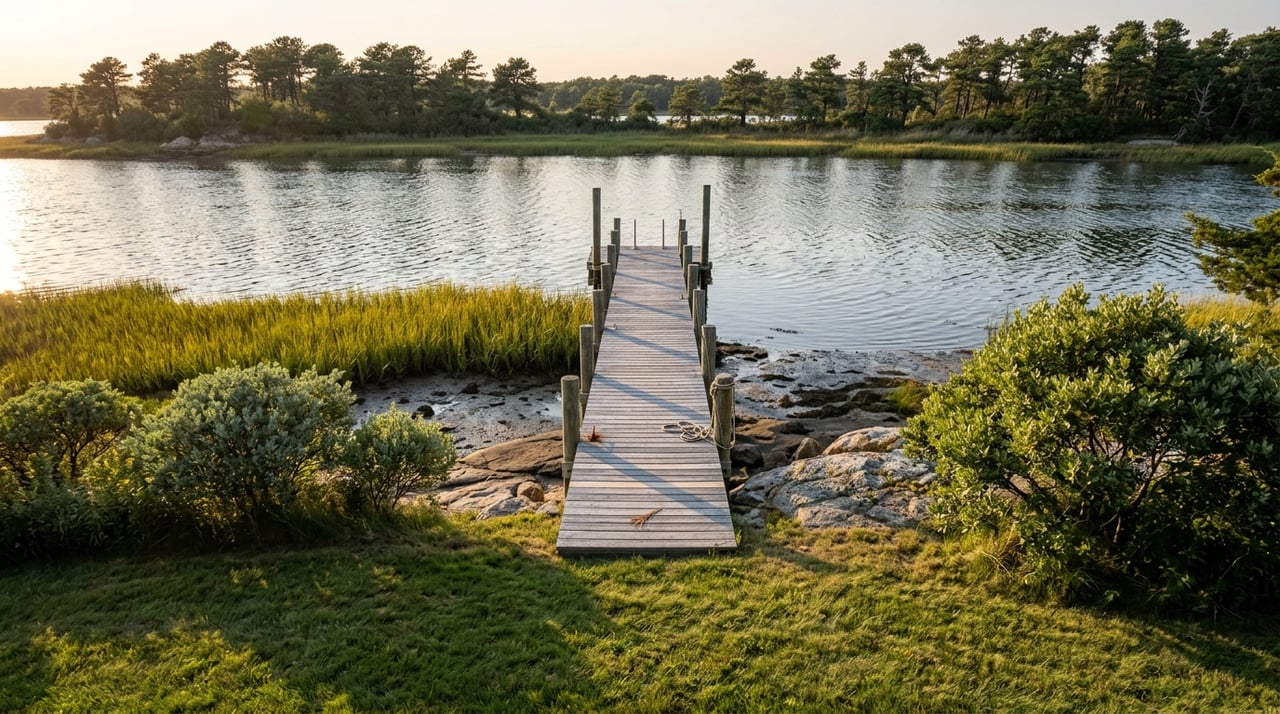
Picture touring a harbor-view property in Gloucester with a private float bobbing at the end of a short dock. The agent points out the water access as a selling point, and it is easy to assume the dock simply transfers with the deed like the kitchen cabinets or the boiler. It doesn't. In Massachusetts, any pier, ramp, or float sitting on tidal water is governed by its own license from the state, separate from the deed, and separate from the house. If that license was never filed, was let to lapse, or was never issued for that structure at all, the dock you toured may not legally belong to the next owner the way you'd expect.
That single detail is a small preview of a larger fact about buying along Gloucester Harbor: the rules that apply to a "waterfront" property depend heavily on exactly where that property sits, and the difference is invisible on a spec sheet.
The law behind this is Chapter 91, the Massachusetts Public Waterfront Act, and it is the oldest waterways licensing program in the country, dating to 1866. Its basic premise is that the shore and the water below the high-tide line belong to the public, not to whoever owns the adjacent land, so any structure that touches that water needs state authorization. The Massachusetts Public Waterfront Act guide lays out the distinction the state draws between water-dependent uses, like piers, wharves, and floats, and nonwater-dependent uses, like the house itself.
For an ordinary residential dock, getting a license is usually routine. The friction shows up during a sale, when a buyer's attorney or lender wants to confirm the license is valid, transferable, and matches the structure that's actually there. A dock built without a permit, or expanded past what was originally licensed, can turn a straightforward closing into a delayed one. This is worth asking about before you fall in love with the float.
Chapter 91 is the baseline. Layered on top of it, in a handful of Massachusetts harbors, is something stricter: the Designated Port Area, or DPA. Gloucester Inner Harbor is one of only ten DPAs in the state, set aside specifically to protect commercial fishing, shipping, and marine industry from being pushed out by condos, restaurants, or offices.
Here's the part that actually matters for a buyer weighing Gloucester waterfront: not every harbor-adjacent parcel is inside that boundary anymore. In a 2014 boundary review, the state's Office of Coastal Zone Management removed East Gloucester and Smith Cove from the Inner Harbor DPA entirely. The reasoning, stated plainly in the agency's own designation decision, was that those areas were "dominated by residential and non-industrial buildings" and had been that way for decades, making them a poor fit for industrial-use protections. That decision is why a home in East Gloucester or Smith Cove today is treated, for zoning and redevelopment purposes, like ordinary residential waterfront. A comparable parcel closer to the working harbor's industrial core may not be.
The clearest current example of what stays inside the boundary is the city-owned I4C2 parcel at 65 Rogers Street, at the heart of Gloucester's inner harbor. Earlier this year, between March and June 2026, the city ran a structured public visioning process to shape what comes next for that site. The city's own project page is explicit that any future use has to satisfy Water-Dependent Industrial Use, the same standard applied throughout the DPA, and that the framework includes the Designated Port Area, the Harbor Plan, and Marine Industrial zoning working together. Whatever eventually gets built on I4C2, it won't be condominiums.
That 65 Rogers Street process sits inside a bigger, slower-moving document: the Gloucester Municipal Harbor Plan, which the Massachusetts municipal harbor plan decisions record as renewed and approved by the state in July 2025 after years of public meetings, economic studies, and site-specific negotiation going back to 2021. The plan doesn't touch residential neighborhoods like East Gloucester or Smith Cove, since those are already outside the DPA. It governs the working harbor itself, places like Harbor Loop and the piers along Rogers Street, where the priority is keeping fishing infrastructure intact rather than opening the door to waterfront housing.
| Outside the Designated Port Area | Inside the Designated Port Area | |
|---|---|---|
| Example locations | East Gloucester, Smith Cove, Eastern Point, the residential shoreline near Rocky Neck | Harbor Loop, the working piers off Rogers Street, the I4C2 parcel |
| Typical current use | Single-family homes, condos, private docks and slips | Fish processing, marine industrial, commercial vessel dockage |
| Chapter 91 still applies to | Any dock, float, or pier touching tidal water | Any structure touching tidal water, plus the added DPA use restriction |
A quick way to see this in the market: search for waterfront listings near Harbor Loop and you'll mostly find industrial space, not homes. A 7,400-square-foot industrial building on Harbor Loop, in Gloucester's Harbor Cove, was recently marketed as leasable industrial space rather than residential property.
As of August 2026, Gloucester had 55 waterfront homes on the market with a median listing price around $895,000, moving in roughly 50 days and drawing about 3 offers on average. Broken down by neighborhood, East Gloucester's median list price stood near $1.13 million in July 2026, while Smith Cove's median list price was closer to $739,000 in June 2026.
Those numbers, on their own, look like a simple story about square footage and lot size. But both East Gloucester and Smith Cove sit fully outside the DPA, and the price gap between them comes down to location, frontage, and the kind of house sitting on the lot. That's actually the useful takeaway: once you know a listing is outside the working port boundary, the median price you're comparing it to is measuring the thing you think it's measuring. Inside the boundary, there's effectively no comparable residential inventory to measure against at all.
If you're seriously comparing Gloucester harbor properties, a few questions are worth asking before you get attached to a specific address:
None of these questions will show up on a standard listing sheet, and none of them are the kind of thing a portal search filters for. They're the kind of thing you find out by asking someone who tracks Gloucester's harbor rules the way other buyers track school boundaries.
Does every waterfront home in Gloucester need a Chapter 91 license? Only structures that touch tidal water, like docks, floats, piers, and seawalls, need a license. The house itself generally doesn't, but any water-touching structure does, regardless of whether the parcel is inside or outside the DPA.
How do I find out if a specific property is inside the Designated Port Area? The state's Office of Coastal Zone Management maintains official DPA boundary maps, and Gloucester's Community Development Department can confirm a parcel's status directly.
Does being outside the DPA mean there are no waterfront rules at all? No. Chapter 91 licensing for any dock or pier still applies everywhere along the harbor.
Gloucester's harbor rewards buyers who look past the view and ask what a parcel is actually permitted to do. If you're comparing waterfront addresses along Gloucester Harbor and want a clear read on what a specific property allows, Annie McClelland and the team can walk the parcel's history with you before you write an offer. And if you're the one holding a harbor property and wondering what these rules mean for your own home's value, Request a Home Valuation and we'll factor in exactly where your line falls.
This article is general information, not legal, tax or financial advice. Consult a qualified professional about your situation.
While our experience in sales, marketing, and negotiation gives us an edge, it’s the relationships with our clients, agents, and community that we value most. If you’re looking for honest guidance, creative solutions, and a team that genuinely loves what we do, we’d love to connect.
McClelland Del Rio Group
21 Central St Manchester by the Sea MA 01944