
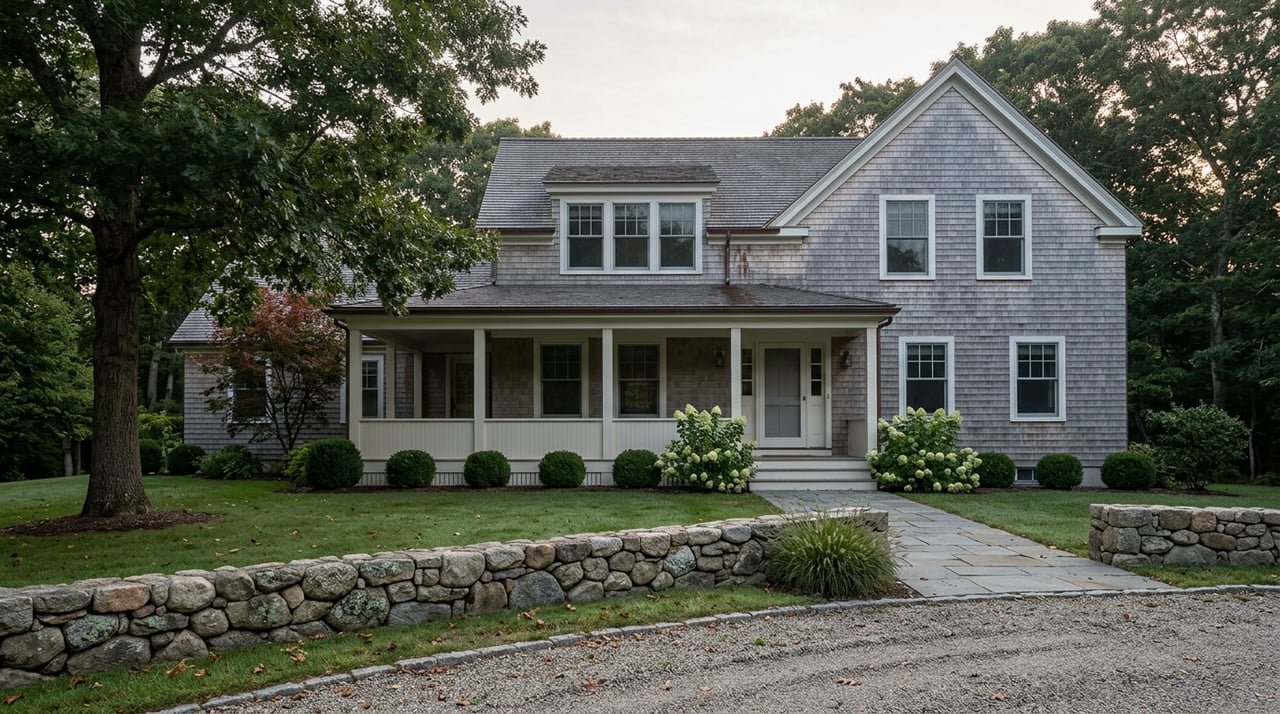
A buyer touring a stone-walled property on one of Hamilton's back roads will usually fall for the barn before they think about the deed. The paddocks look right, the fencing is already up, and the listing photos lean hard on the equestrian fantasy. What almost nobody checks before writing an offer is whether the lot actually clears the acreage threshold the town requires before a horse can legally live there.
That question is not a technicality. It is the hinge on which Hamilton's entire housing market swings, and it explains something that trips up almost every buyer comparing this town to its neighbors: the median price you find depends entirely on which Hamilton you mean.
Hamilton's Board of Health regulates horse keeping directly, and the math is specific enough to run before you get emotionally attached to a listing. The first three horses on a property require a minimum of 80,000 square feet of suitable land, which works out to a little under two acres. Every horse beyond that third one needs an additional 20,000 square feet, roughly another half acre. Whoever keeps the horses also needs a Keeping of Animals Permit from the Board of Health, and that permit expires every June 30 and has to be renewed annually.
Run the numbers on a five-acre listing, which is a common size in Hamilton's outer neighborhoods. Five acres is about 217,800 square feet. Subtract the 80,000 required for the first three horses and you have 137,800 square feet left, which divides into six more horses at 20,000 square feet each. That property can legally support nine horses, not the twelve a buyer might assume from acreage alone, and not the unlimited number the listing photos might imply.
This is the calculation a buyer needs before falling for a barn, not after. A property that looks identical to its neighbor from the road can support a very different number of animals depending on exact square footage, and the difference shows up in resale value to the next equestrian buyer.
Hamilton's own market data makes almost no sense until you separate it by geography. Town-wide, Hamilton homes listed at a median price of $1.29 million in June 2026. Listings across the town also carried a median price of $371 per square foot. Just down the road, in the South Hamilton village center around the ZIP code 01982, the median list price in August 2026 was $825,000, at a median of $300 per square foot.
| Hamilton, town-wide | South Hamilton village (01982) | |
|---|---|---|
| Median list price | $1.29M (June 2026) | $825K (August 2026) |
| Median price per sq. ft. | $371 | $300 |
That is not two snapshots of the same market taken a couple months apart. It is two different markets being reported under one town name. The town-wide figure gets pulled upward by large-lot estate properties in the outer neighborhoods, while the village figure reflects smaller lots clustered near downtown and the train station. A buyer who Googles "Hamilton MA median home price" and anchors to $1.29 million is pricing themselves out of a home they could actually afford in South Hamilton village, and a buyer anchored to $825,000 is going to be surprised by what land in horse country actually costs.
The temptation is to read this gap as prestige pricing, as if the outer neighborhoods simply cost more because they sound more exclusive. The zoning bylaw tells a more useful story. Hamilton's code includes a dedicated Estate Overlay District with its own open space and access requirements layered on top of standard lot rules, applied specifically to the larger-lot areas outside the village core. Combine that with the Board of Health's acreage math for keeping horses, and you get a town where the land itself is regulated into two different products. One product is a walkable village lot sized for a single-family home. The other is a parcel sized to support the specific number of animals a buyer wants, with open space obligations built in.
The price gap between $1.29 million and $825,000 is not a matter of taste. It is what happens when a town's own rules require meaningfully more land in one part of it than another.
Here is the detail that catches even careful buyers off guard. The commuter rail stop that pulls South Hamilton's prices toward walkable convenience is called Hamilton/Wenham, and it straddles the town line between the two. The platform itself extends far enough south that its far end sits geographically in Wenham. The station offers direct service to Boston's North Station, with the ride running close to fifty minutes.
That means the thing making South Hamilton's village prices more approachable, easy rail access, is not fully a Hamilton amenity at all. It belongs to both towns at once, which is part of why the Hamilton-Wenham school district, library, and recreation department are shared rather than separate. A buyer weighing a village-center property should factor in that the walk-to-the-train lifestyle they are paying for is a shared regional asset, not something unique to one side of the line.
The outer neighborhoods carry a cultural weight that shows up in marketing even when it does not show up in the zoning code. Myopia Hunt Club holds polo matches most Sunday afternoons and a public Thanksgiving Day fox hunt that draws spectators from around the region. The horse farms that ring the club are a visible part of daily life in that part of town, and listing photography for estate properties leans on that imagery constantly.
It is worth separating the culture from the requirement. Myopia's presence does not itself dictate how much land a property needs. That comes from the Board of Health regulation. What Myopia does is make the acreage requirement feel like a lifestyle choice rather than a bureaucratic minimum, which is exactly why buyers underestimate how literally the town enforces it.
A few questions are worth answering before a showing turns into an offer:
None of these questions show up on a standard listing sheet. They come from reading the town's own regulations, which is worth doing before a buyer's agent puts a number on paper.
If you are choosing between village-center convenience and outer-town acreage, treat them as two separate searches rather than one town-wide hunt. Compare South Hamilton listings against other walkable, train-accessible North Shore villages. Compare estate-zone listings against other equestrian communities where the same acreage math applies. Blending the two searches is how buyers end up either overpaying for land they don't need or underestimating what a working horse property actually costs to run legally.
Does every property in Hamilton allow horses? No. The Board of Health's minimum land requirement of 80,000 square feet for up to three horses applies regardless of a property's marketing description, and smaller village lots typically cannot meet it.
Is Hamilton's town-wide median price a useful number for a buyer? Only as a starting point. Given the gap between the town-wide figure and the South Hamilton village figure, a buyer should ask which submarket a given median actually represents before using it to set expectations.
Comparing Hamilton's village and estate markets side by side takes more than a portal search. If you're weighing a walkable South Hamilton property against a horse-country listing and want the acreage, zoning, and pricing questions answered before you tour, McClelland Del Rio Group can walk you through both sides of town and what each one actually costs to own.
While our experience in sales, marketing, and negotiation gives us an edge, it’s the relationships with our clients, agents, and community that we value most. If you’re looking for honest guidance, creative solutions, and a team that genuinely loves what we do, we’d love to connect.
McClelland Del Rio Group
21 Central St Manchester by the Sea MA 01944